Lithium Battery for Inverter: How to Check Compatibility Before Replacing Lead-Acid Batteries
Planning to replace a lead-acid battery? Learn how to check lithium battery compatibility with your inverter, including voltage, charging settings and BMS.
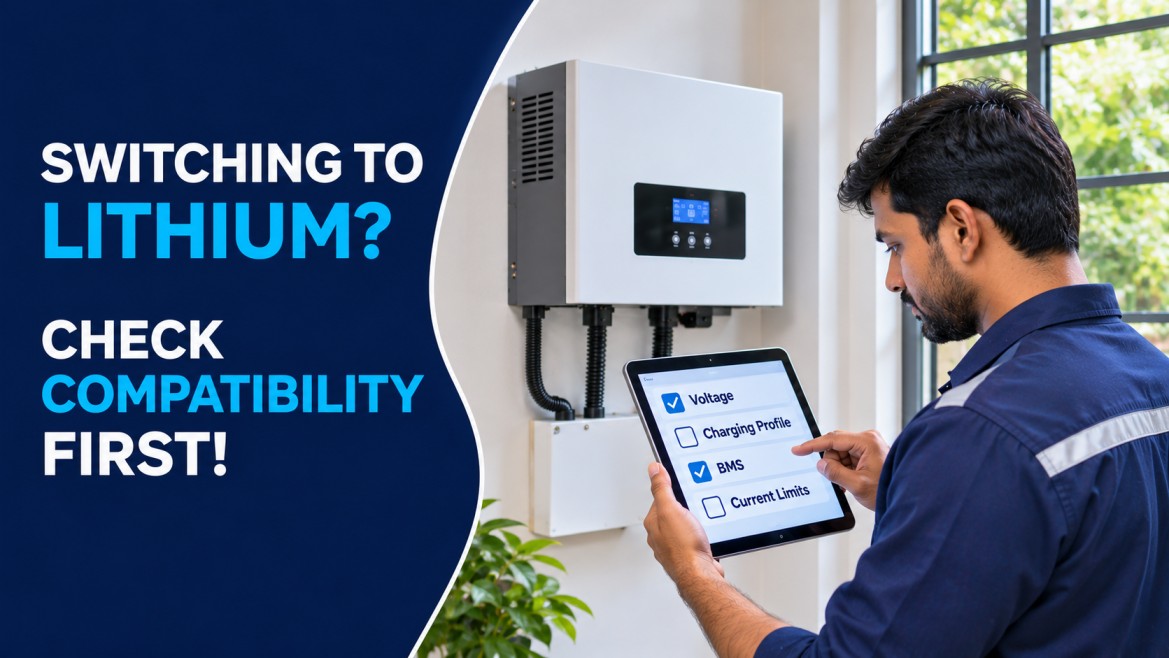
If you're thinking of upgrading your traditional lead acid battery to a lithium battery, you are far from alone. Many homeowners are looking for a lightweight, low-maintenance backup solution. However, upgrading to a Lithium Battery for Inverter is not quite as easy as plugging one battery out and plugging the new battery in. There are several factors to consider such as the voltage, charging settings, battery management system and power of your inverter to ensure your current inverter is compatible with a lithium battery.
Can You Use a Lithium Battery With an Existing Inverter?
Yes, there are inverters that will work with lithium batteries, but this will depend on their electrical specs.
If the inverter was designed to work with lead acid batteries there may be charging profiles that are unsuitable for lithium batteries.
Some inverters will have a set charge voltage or equalisation settings that are designed for flooded batteries.
In these cases you may need to change your inverter, or ensure you have an approved charging setup.
Check Battery Voltage Before Upgrading
The first thing you need to consider is the voltage of the Lithium Battery.
Most home inverter systems use 12v, 24v or 48v batteries.
But there's more to it than that!
Understanding Nominal and Operating Voltage
A 12.8V LiFePO4 may be described as a 12V battery but its charge voltage and voltage range will not match a standard 12V lead-acid battery.
So always ensure that the full voltage range is compatible with your inverter DC inputs.
Don't assume it will work just because the voltages match.
Understand Lithium Battery Charging Requirements
Lead acid vs lithium charging profiles.
Lead acid charging profiles will often include bulk, absorption, float and equalisation phases.
Lithium iron phosphate batteries will usually use a suitable charging profile without an equalisation phase typically used on lead acid.
What Should You Check?
Verify the following:
- Maximum charge voltage
- Recommended charge current
- Lithium charging mode available
- Float charging requirements
- Equalisation settings
- Battery temperature protection
If your inverter has a custom charge setting option, it may be possible to have a qualified technician program it with correct settings as per the battery manufacturers specs.
Do not copy charge settings from another brand of battery without referring to the relevant datasheet.
Why Is BMS Compatibility Important?
A Battery Management System will monitor key parameters within the lithium battery.
Depending on how it is designed, it can prevent overcharge, deep discharge, short circuits and unsafe temperatures.
The inverter will have to work within safe charge and discharge ranges of the battery.
Check Continuous and Peak Current
Sometimes inverters can cause heavy currents to flow.
This may cause the battery to disconnect if it goes above the maximum discharge current set by the BMS.
Some more advanced systems will require the Inverter to communicate with the BMS using appropriate communication protocol.
Always check whether your selected equipment requires communication.
Compare Battery Capacity in Ah and kWh
When replacing lead acid batteries, it is important to understand that just looking at ampere hours can be misleading.
Lithium batteries will have a different usable energy due to the recommended depth of discharge.
Energy = Volts x Ah
A 12.8v 100Ah battery will have a nominal energy of approx 1,280Wh or 1.28Kwh.
The actual usable energy will depend on the safe operating conditions, battery state and inverter efficiency.
This will help to give a more accurate comparison between batteries when purchasing.
Avoid These Common Installation Mistakes
When upgrading your batteries to Lithium there are a few common mistakes people make:
Incorrect charging profile settings, not taking BMS current limits into account, and using cables that are too small.
Generally it is not suitable to mix Lithium and Lead Acid batteries together unless your system has been specifically designed to do this.
Professional installation will ensure your protection, cables and wiring are correct.
Explore Lithium Battery Solutions From Deepmala Power
We offer battery and power back up solutions.
If you work with businesses or are a homeowner looking to go lithium then look at our Lithium Battery Category and get in touch with us for the right specification.
Before purchasing ask for the battery data sheet. Make sure it is compatible with your current inverter.
Frequently Asked Questions
1. Can I Replace a Lead-Acid Battery With Lithium in My Inverter?
Yes, if the inverter supports the lithium battery's voltage, charging requirements and discharge limits. Some installations may require equipment upgrades.
2. Does a Lithium Battery Need a Special Inverter?
Not always. Certain inverters support lithium or adjustable charging profiles, while others may not be compatible.
3. Can a 12V Inverter Use a 12.8V Lithium Battery?
Possibly. Many 12.8V LiFePO4 batteries are designed for 12V-class applications, but the full operating voltage range must be checked.
4. Is BMS Necessary for a Lithium Inverter Battery?
Yes. Lithium battery systems require appropriate monitoring and protection, usually provided through a compatible BMS.
5. Will a Lithium Battery Increase Inverter Backup Time?
It may provide more usable energy than a comparable lead-acid battery, but actual backup depends on capacity, appliance load and system efficiency.
6. Can I Use My Existing Lead-Acid Battery Charger for Lithium?
Only if its charging parameters meet the lithium battery manufacturer's requirements. Incompatible charging settings can damage the battery.
Conclusion
By upgrading to a Lithium Battery for Inverter you will reduce the maintenance and have an efficient alternative to using lead-acid batteries. However, you must ensure that the battery is compatible with your voltage, charging profile, BMS limitations and installation requirements.
By using a properly matched system you are ensuring safe operation and reliable back-up.
Contact us at Deepmala Power for information on our range of battery solutions and speak to our technical team about your inverter compatibility requirements.