Battery Manufacturer in India: Important Battery Quality Tests Every Buyer Should Know
Learn about 7 essential battery quality tests, including capacity, charging, safety, and cycle life, to help buyers choose a reliable battery manufacturer in India. Copy
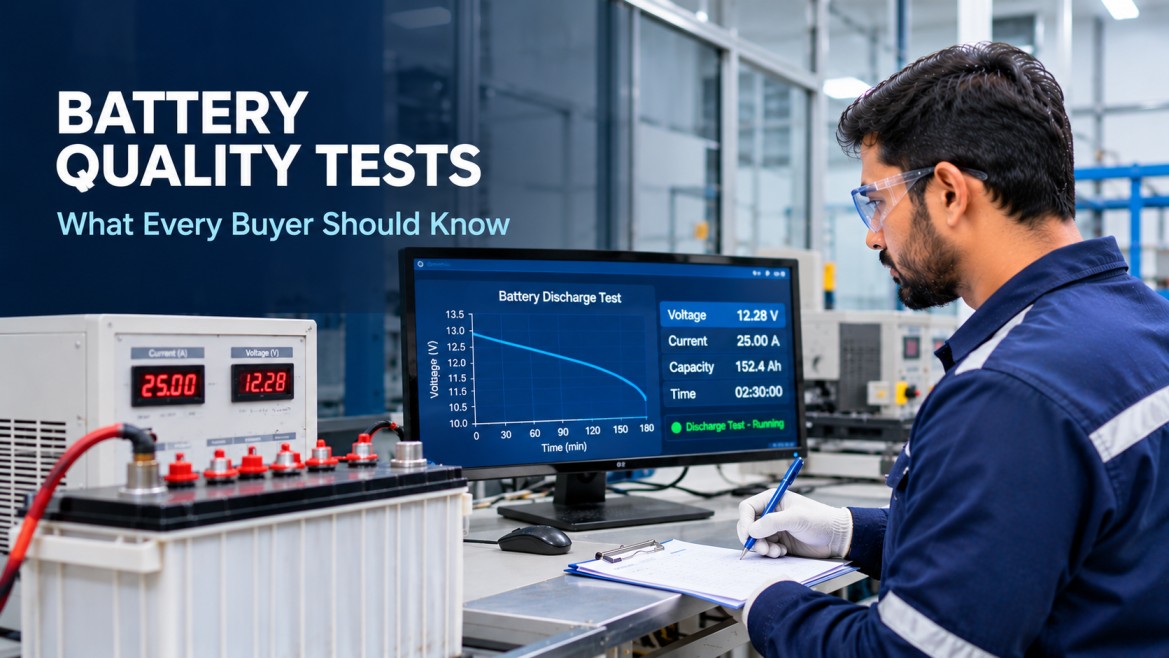
While a battery may appear to be in perfect condition, it is important to test its performance after prolonged usage. A reputable Battery Manufacturer in India will ensure that they are tested for their capacity, charging characteristics, electrical performances, safety and overall longevity. This allows dealers, distributors and those buying in bulk to easily understand how to compare products, ensuring they are meeting the specifications and minimising any issues with the batteries unexpectedly failing.
Why Is Battery Quality Testing Important?
You place an order for 200 inverter batteries. All arrive with the correct labelling and packaging. However, some do not provide the expected level of backup.
This shows how you can't determine the quality of your batteries by just looking at them.
Testing helps you to determine any faults during manufacture, inconsistencies and potential issues that could occur during typical use.
Each battery technology requires its own test. Automotive, Tubular, VRLA and Lithium batteries should be tested to the right standards for their application.
1. Battery Capacity Testing
Capacity testing determines if the battery can supply the rated level of electrical energy.
This is often expressed in ampere-hours (Ah).
The rated capacity of a 150Ah battery will only have relevance when the discharge rate, temperature and final voltage are known.
Why Does Capacity Testing Matter?
If a battery does not deliver its full capacity then it will not offer the expected back-up time.
Manufacturers will test using regulated discharge equipment.
When buying batteries ask what capacity they have been rated for and under what conditions.
2. Charging and Charge Acceptance Testing
The battery must accept charge according to its recommended parameters.
Battery charge acceptance refers to the ability of a battery to accept charge under certain conditions.
Low charge acceptance can cause long charge times. It can also mean that the battery does not fully recover after discharge.
A responsible Battery Manufacturer in India should be able to give you the correct charging voltages and currents for your battery models.
3. High-Rate Discharge Testing
Applications require high current for short periods.
This can be seen in automotive batteries where high current is required during engine start up.
By testing high rate discharge you can understand how well the battery will perform under high loads.
Cold Cranking Amps (CCA) is a standardised rating used to give an indicative value for starting capability at low temperatures for starting batteries.
CCA is not the key criteria for selecting inverters or solar batteries.
4. Charge Retention Testing
What happens if your batteries are not used for several weeks?
All batteries experience some degree of self discharge
Charge retention tests investigate how well your battery will retain its charge during storage under given conditions.
This is especially important if you are a distributor with stock in your warehouse.
Temperature, battery chemistry and age can all affect charge retention.
5. Cycle Life and Endurance Testing
Battery performance will change due to repetitive charge/discharge cycles. Cycle life testing is used to determine how a battery will perform after repetitive charge/discharge cycles under specific conditions.
Why Is Cycle Testing Useful?
Batteries may have excellent performance at the start, but can suffer losses in capacity if used frequently. Endurance tests are carried out by manufacturers to assess this.
However, it is not possible to directly relate the number of cycles in the lab to years of usage in the real world.
The life of battery in actual use will depend on the conditions and maintenance.
6. Vibration and Physical Inspection
Batteries may experience vibration during transportation, installation or vehicle operation.
Relevant vibration tests evaluate whether construction and internal connections can withstand specified mechanical stress.
Physical inspections also examine containers, terminals, seals, dimensions and visible defects.
These checks help identify damage before products reach customers.
7. Battery Safety and Protection Testing
Safety requirements depend on battery chemistry and intended use.
For lithium systems, testing may include overcharge protection, over-discharge protection, temperature monitoring and Battery Management System (BMS) functions.
For lead-acid batteries, appropriate assessments may include leakage, mechanical integrity and relevant charging-related safety checks.
Buyers should verify which standards and test reports apply to the exact product.
How to Evaluate a Battery Manufacturer in India
Before placing a large order, ask for the product datasheet, applicable test documentation and warranty conditions.
Also, confirm batch identification, manufacturing dates and the procedure for handling defective products.
The Bureau of Indian Standards provides information about Indian standards, while accredited laboratories can conduct relevant battery testing.
Explore Battery Solutions From Deepmala Power
Deepmala Power Industries offers tubular battery and energy-storage solutions for inverter, UPS and solar applications.
Buyers can explore its product categories and discuss technical specifications before making purchasing decisions.
For bulk requirements, request model-specific capacity ratings, charging recommendations, applicable quality documents and warranty information.
Frequently Asked Questions
1. What Is the Most Important Battery Quality Test?
Capacity testing is important because it verifies rated performance. However, the necessary tests depend on battery type and application.
2. How Do Manufacturers Test Battery Capacity?
They discharge a battery under controlled conditions and measure the charge delivered before reaching the specified cut-off voltage.
3. Why Is Cycle Life Testing Necessary?
It helps evaluate how battery performance changes after repeated charging and discharging under defined laboratory conditions.
4. Do Lithium and Lead-Acid Batteries Require Different Tests?
Yes. Their chemistry, operating behaviour and safety requirements differ, so applicable testing procedures are not identical.
5. Can Battery Testing Guarantee a Long Service Life?
No. Testing supports quality assessment, but real-world battery life also depends on charging, temperature, usage and maintenance.
6. What Documents Should Bulk Battery Buyers Request?
Request technical datasheets, applicable test reports, warranty terms, manufacturing identification and relevant certification information.
Conclusion
Choosing a Battery Manufacturer in India requires more than checking price, capacity and packaging. Battery quality tests provide useful evidence about charging performance, durability, electrical capacity and safety.
Understanding these tests helps buyers make informed decisions and compare products on meaningful specifications.
For battery and power backup requirements, explore Deepmala Power Industries and request the technical details relevant to your application.